Concrete Slab Cost Calculator
This concrete slab cost calculator gives you a full slab budget, not just a per-square-foot guess: concrete, compacted gravel base, reinforcement, forms, and labor, itemized separately and priced as either a DIY or contractor job. Every price is editable, and the total shows as a realistic range instead of one falsely precise number.
Price edits are remembered on this device — no account, nothing sent anywhere.
Estimates only, not quotes. Prices are editable national averages — confirm current pricing and quantities with your supplier before you buy.
How this concrete slab cost calculator prices the job
Enter the slab's footprint and thickness, then choose reinforcement (none, wire mesh, or a rebar grid), whether to include a compacted gravel base and how deep, the finish, and whether you're pricing a contractor job or a DIY pour. A regional cost-level selector scales labor up or down — material commodity pricing (concrete, gravel, mesh) doesn't move as much region to region as skilled labor does, so it's applied to the labor line only.
Each material line is computed from your actual dimensions — concrete volume includes a 10% waste allowance for a professionally formed pour, and gravel volume includes 15% for compaction, since a base settles below its loose-poured depth once it's tamped. Labor is priced per square foot by finish (stamped costs several times more per foot than broom, mostly in skilled labor and decorative additives), and a flat tool-rental line stands in for labor if you mark the job DIY.
Rather than one falsely precise total, the calculator rounds to the nearest $50 and shows a realistic ±10% range around it — real contractor bids for the identical job routinely spread that much based on crew, schedule, and site access.
The formula
Area = Length (ft) × Width (ft). From there, every line comes from area:
Worked example: a 12×20 slab cost, itemized
The calculator's own defaults: a 12 ft × 20 ft slab, 4 in thick, wire mesh, a 4 in compacted gravel base, broom finish, contractor mode, and a typical-cost region.
- 1. Area12 × 20 = 240 sqft
- 2. Concrete240 × (4÷12) ÷ 27 × 1.10 = 3.26 yd³ × $165 = $538
- 3. Gravel240 × (4÷12) ÷ 27 × 1.4 × 1.15 = 4.77 tons × $45 = $215
- 4. Wire mesh240 × $0.35 = $84
- 5. Forms & misc240 × $0.30 = $72
- 6. Materials subtotal$538 + $215 + $84 + $72 = $909
- 7. Labor (broom, typical)240 × $2.75 × 1.00 = $660
- 8. Contractor total$909 + $660 = $1,569 → $1,550 typical ($1,400–$1,700)
- 9. DIY total$909 + $120 rental = $1,029 → $1,050 typical ($950–$1,150)
- 10. Cost per sqft$6.46 contractor vs $4.38 DIY
The $500 gap between the two typical totals ($1,550 vs. $1,050) is the DIY-vs-contractor delta shown in the results — almost exactly the $660 labor line minus the $120 rental cost, since the material total is identical either way.
Concrete slab cost by size
Typical installed costs for common US slab sizes, all priced with this calculator's default recipe — 4-inch slab, wire mesh, 4-inch compacted gravel base, broom finish, typical-cost region — except the garage row, which uses the 6-inch, rebar-grid spec a parked vehicle calls for. Contractor figures include labor; DIY is materials plus the flat $120 tool rental.
| SLAB | SIZE | CONTRACTOR* | DIY* |
|---|---|---|---|
| Small patio | 10 × 10 ft | $600 – $700 | $450 – $550 |
| Patio | 12 × 12 ft | $850 – $1,050 | $600 – $700 |
| Large patio (defaults) | 12 × 20 ft | $1,400 – $1,700 | $950 – $1,150 |
| Big patio / small shop | 20 × 20 ft | $2,350 – $2,850 | $1,500 – $1,800 |
| 2-car garage† (6 in, rebar) | 24 × 24 ft | $4,250 – $5,150 | $2,950 – $3,600 |
* ±10% ranges around the nearest-$50 typical, computed with the exact formula above at July 2026 default prices. † Garage slabs usually need thicker pours and permits — verify requirements with your local building department.
What actually moves the price
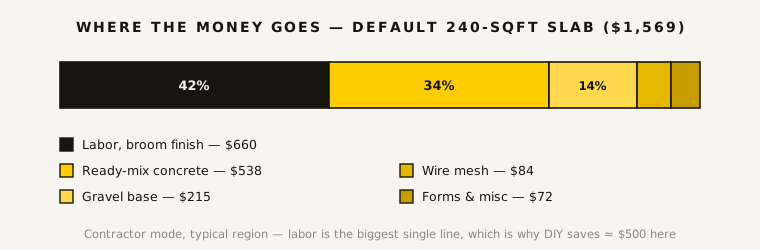
Because labor and concrete dominate, the price levers rank very differently than most people guess. On the default 240-square-foot slab, each change moves the total by roughly:
- broom → stamped finish ······ +$1,260 (the single biggest lever)
- 4 in → 6 in thickness ······ +$269 of concrete
- typical → high-cost region ······ +$132 of labor
- mesh → rebar grid ······ +$120
- skip the gravel base ······ −$215 (usually a false saving on soft soil)
And the biggest lever of all is the one this page prices explicitly: doing the labor yourself — about $500 on the default slab after paying for tool rental. That's why the DIY/contractor toggle sits at the top of the calculator instead of buried in the fine print.
Assumptions & defaults
| Concrete waste | 10% (fixed) |
| Gravel base compaction | +15% over loose volume |
| Gravel density | 1.4 tons/yd³ |
| Reinforcement (editable) | Mesh $0.35/sqft · rebar $0.85/sqft |
| Labor by finish (editable) | Broom $2.75 / Smooth $3.25 / Stamped $8.00 per sqft |
| Region multiplier | Low ×0.85 / Typical ×1.00 / High ×1.20 · labor only |
| DIY tool rental (editable) | $120 flat, in place of a labor line |
| Displayed range | Nearest $50, shown ±10% |
Concrete and gravel figures round to two decimals before their cost is calculated, so every line multiplies out exactly as printed — you can check any row with your own calculator. Every price field is a labeled, editable national-average estimate, reviewed July 2026; overwrite any of them with your own supplier's or contractor's numbers and the estimate updates immediately. See how our price reviews work.
Concrete patio cost vs concrete driveway cost
A concrete patio cost and a concrete driveway cost run through the same lines on this page — the difference is thickness and steel. A patio carrying furniture is fine at 4 inches with wire mesh; a driveway carrying vehicles wants 5–6 inches with rebar, and moving from 4 to 6 inches alone raises the concrete line by 50% before the heavier reinforcement is counted. Enter your own dimensions with the right thickness and the itemized total above IS your patio or driveway number — and the concrete calculator will translate the same pour into bags and truck loads.
Two neighbors of this job are priced on their own pages: the compacted base under the slab (tonnage via the gravel calculator) and the slab-plus-building case — if the pour is under a new garage, the cost to build a garage calculator prices the whole structure with this slab carved out as its own line. And if the slab you are replacing merely sank, check the concrete leveling cost guide before demolishing it — lifting an intact slab at $3–$8 per square foot usually beats re-pouring it.
Sources & standards
Concrete yield and reinforcement-type guidance follow the same manufacturer bag/yield data referenced on the Concrete Calculator and ACI CODE-332-20, Residential Code Requirements for Structural Concrete, published by the American Concrete Institute. Ready-mix ordering conventions reflect National Ready Mixed Concrete Association (NRMCA) published guidance. Aggregate base density and compaction figures reflect published aggregate-supplier product data sheets for crushed stone and road base. Permit and inspection requirements are set locally; this page doesn't cite a national standard for them — confirm scope and fees with your local building department before you budget a permit line.