Concrete Leveling Cost: Mudjacking vs Foam, Priced
Concrete leveling costs $3–$8 per square foot for mudjacking and $5–$25 for polyurethane foam, with most whole jobs landing between $500 and $2,500 — against roughly $8–$18 per square foot to demolish and re-pour the same slab. This page prices both lifting methods and the replacement they compete with, works a sunken 240 sq ft driveway section line by line, and covers the cases where lifting is the wrong fix — because concrete never sinks without a reason, and the reason is usually still there.
TallyTakeoff Editorial · Published
How concrete leveling is priced
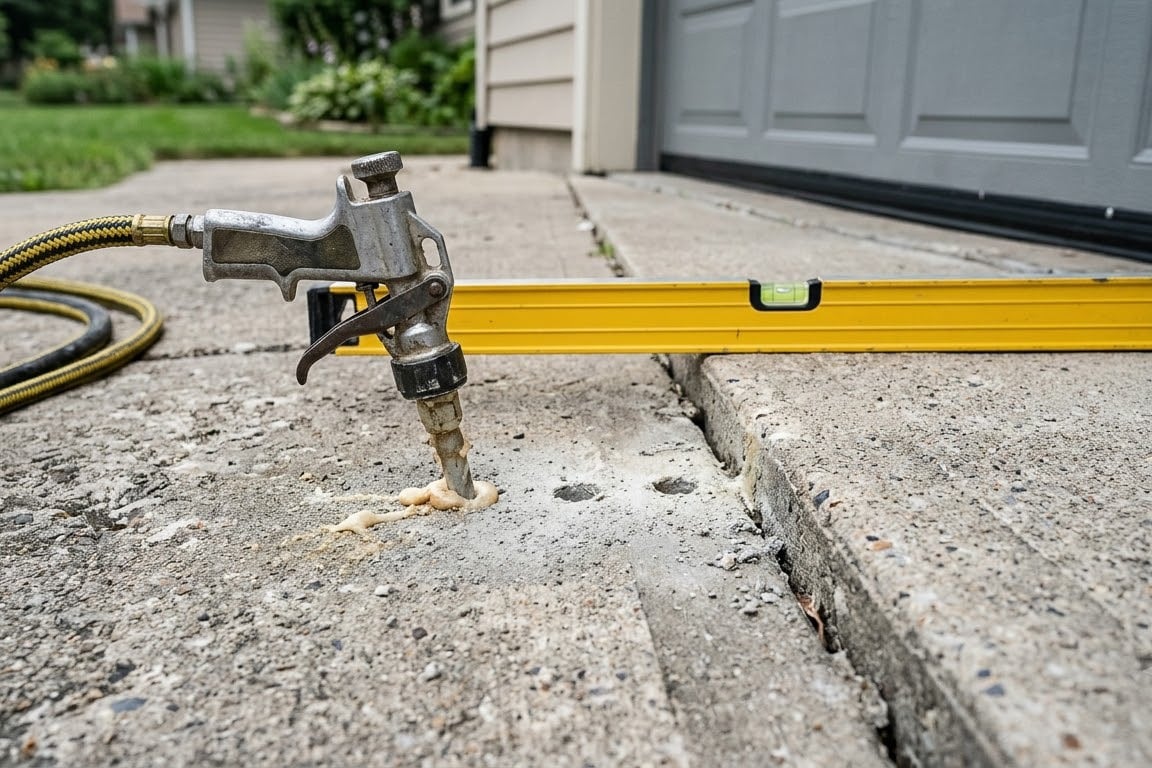
Slab jacking — mudjacking or foam — drills small ports through the sunken slab and pumps material underneath until the slab rises back to grade. You are quoted by the slab’s area, but what the contractor is actually estimating is the volume going under it.
Leveling cost ≈ slab area (sq ft) × per-square-foot rate for the method, where the rate rides on lift height and void size — plus a job minimum, commonly $250–$550, that small jobs bill at regardless of area.
That is why a slab sunk half an inch and a slab sunk four inches get different quotes for the same square footage, and why a single sidewalk square almost always bills at the minimum: the truck, pump and crew cost the same to mobilize whether they pump two gallons or two hundred.
Concrete leveling cost by method
| Method | Typical cost | When it is the right fix |
|---|---|---|
| Mudjacking (cement slurry) | $3–$8 /sqft | The budget lift: slurry pumped through 1⅝–2 in ports. Best on larger voids over stable soil; keep vehicles off for a day or two while it cures. |
| Polyurethane foam (polyjacking) | $5–$25 /sqft | Expanding foam through ⅝ in ports, cured in about 15 minutes. Most residential lifts land at $5–$12; the top of the range is deep voids and heavy slabs. |
| Self-leveling underlayment (interior) | $35–$45 per 50-lb bag | A different problem: smoothing an interior floor before flooring goes down, not lifting a structural slab. Genuine DIY — one bag covers 40–50 sq ft at ⅛ in. |
| Grinding a trip lip | $75–$250 per spot | A raised edge of half an inch or so at a joint. Grinding the lip flat is faster and cheaper than lifting either slab, when height — not a void — is the whole problem. |
| Full replacement | $8–$18 /sqft | Demolition and haul-away at $2–$6/sqft plus a new slab at $6–$12 installed. The fallback when the slab is cracked apart or the surface is failing. |
National-average estimates, reviewed July 2026. Compiled from the current concrete-leveling cost guides published by the major home-services marketplaces and trade publishers, cross-checked against slab-jacking contractors’ published pricing. Underlayment bag figures come from manufacturers’ data sheets. Lift height moves every per-foot figure more than region does.
What leveling common slabs costs
A single sunken sidewalk square costs $250–$550 — the job minimum, not the math. A 240 sq ft driveway section runs $720–$2,880 depending on method, and a 400 sq ft garage floor $1,200–$4,800. The ranges below put mudjacking at the low end and typical residential foam at the high end.
| Project | Typical range | What drives it |
|---|---|---|
| Single sidewalk square (~25 sqft) | $250–$550 | Bills at the mobilization minimum. If it is the public sidewalk strip, ask the city first — many run repair or cost-share programs for exactly this. |
| Patio, 200 sqft | $600–$2,400 | Usually one or two settled edges rather than the whole field; treating only the sunken panels is legitimate and cheaper. |
| Driveway section, 240 sqft | $720–$2,880 | The classic job: two panels sunk at the garage line. Worked line by line below. |
| Garage floor, 400 sqft | $1,200–$4,800 | Interior work favors foam — small ports, no curing wait, and the slab often carries point loads that argue for the lighter material. |
| Pool deck, 300 sqft | $900–$3,600 | Precision matters: the deck must keep draining away from the pool, so lifts are small and careful. Foam is the common pick. |
Same sources and review date as above; ranges are area × the per-square-foot rates, so they reproduce from the method table. Access, lift height and how many separate slabs the crew must set up on move jobs within — and occasionally beyond — these spans.
Worked example: a sunken 240 sq ft driveway section
Take the driveway job from the table: two panels at the garage line, 12 × 20 ft combined — 240 sq ft — settled about two inches after a wet spring:
- Mudjacking: 240 sq ft × $3–$8 = $720–$1,920 (typical: 240 × $5 = $1,200)
- Polyurethane foam: 240 sq ft × $5–$12 = $1,200–$2,880
- Replacing instead: demolition at $2–$6/sqft ($480–$1,440) plus a new 12 × 20 slab at $1,400–$1,700 installed = $1,880–$3,140
The replacement figure is not hand-waved: $1,400–$1,700 is the default worked example on our concrete slab cost calculator — the same 240 sq ft at 4 inches with mesh, base gravel and broom-finish labor, itemized line by line. Lifting an intact slab costs roughly half of replacing it, and the gap widens the moment demolition is priced honestly.
Estimates only, not quotes. Prices are editable national averages — confirm current pricing and quantities with your supplier before you buy.
Mudjacking vs foam: what the price difference buys
Both methods do the same thing — refill the void and push the slab back up. The differences that matter:
- Weight on the soil that already failed. Cement slurry runs on the order of 100 lb per cubic foot; cured foam is 2–4 lb. Pumping a ton of slurry over soil that could not carry the slab is how the same panel gets lifted twice.
- Port size and patch visibility. Mudjacking drills 1⅝–2 in holes; foam needs ⅝ in. On a patio you look at every day, the smaller patches are part of what you are paying for.
- Return to service. Foam takes foot traffic in minutes and vehicles the same day; mudjacking wants a day or two before the car comes back.
- Price. Mudjacking is the cheaper lift per foot, and on a big, sound slab over decent soil that is a fair reason to choose it.
A fair summary: mudjacking when the budget leads and the soil is sound; foam when the soil is suspect, the slab is heavy, or the job is indoors. Either way the quote should state the method, the port count, and what happens if the slab does not reach grade.
When leveling is the wrong fix
Slab jacking lifts a slab that is intact and sunken. It cannot help when:
- The slab is cracked into several pieces. Each fragment lifts independently; pumping under a jigsaw makes an expensive, uneven jigsaw. Replace it — priced honestly on the slab cost calculator.
- The surface is spalling or crumbling. Lifting rotten concrete buys a level slab that still needs replacing.
- The slab is heaved, not sunken. Tree roots and frost push slabs up. There is no pumping a slab downward — the fixes are grinding the lip or replacing the panel over a root barrier.
- The washout is still running. Lifting a slab under a broken downspout is renting the repair, not buying it.
One boundary stated plainly: this page is about flatwork — driveways, walks, patios, garage floors. If what is settling is the house — stair-step cracks in the foundation, doors going out of square — that is foundation repair with a licensed structural engineer, a different trade at a different price, and nothing on this page applies to it.
Fix the water, then the slab
Sunken concrete is a drainage symptom you can walk on. Before — or at least alongside — any lifting: extend the downspouts four to six feet past the slab, regrade the strip beside it so runoff moves away, and caulk the slab joints after lifting so surface water stops feeding the void. University extension drainage guidance (the same University of Minnesota Extension guide we cite for basements) treats moving roof water as the first fix for every settling-and-seepage problem, and it costs a rounding error against a re-lift. The same logic — and the same downspout list — anchors our basement waterproofing cost guide, because the slab and the basement are usually drinking from the same downspout.
The interior-floor version of DIY is real, though: for a wavy basement or kitchen floor ahead of new flooring, self-leveling underlayment at $35–$45 per 50-lb bag covers 40–50 sq ft at ⅛ inch per the manufacturers’ data sheets — a 12 × 12 room takes about four bags, roughly $140–$180 with primer. And if you are replacing a small broken pad outright, the concrete calculator turns its dimensions into an exact bag count for the re-pour.
Frequently asked questions
How much does it cost to level a concrete driveway?
Is it cheaper to level concrete or replace it?
Which is better, mudjacking or foam?
How long does concrete leveling last?
Can I level concrete myself?
Why did my concrete sink in the first place?
Where these numbers come from
The dollar figures are national-average estimates, reviewed July 2026, compiled from the current concrete-leveling and mudjacking cost guides published by the major home-services marketplaces and trade publishers, cross-checked against slab-jacking contractors’ published price sheets. Underlayment coverage and bag yields come from manufacturers’ product data sheets; the replacement comparison uses our own slab cost calculator’s itemized default example so the two pages can be checked against each other. Drainage sequencing follows the University of Minnesota Extension guidance linked above.
Our full sourcing and review process is on the methodology page. Written and maintained by TallyTakeoff Editorial — no individual bylines, no invented credentials; see about TallyTakeoff for how that works and why.