Roof Replacement Cost: What a New Roof Runs by the Square
Most roof replacements cost $10,000–$15,700 — a typical 2,000 sq ft house reshingled in architectural asphalt at the going $450–$700 per square. Contractors price by the roofing square (100 sq ft of sloped surface), not by the size of the house, and the roof is always bigger than the house under it. This page shows the per-square rate for every common material, the pitch arithmetic that turns a footprint into squares, and one job priced line by line — including the materials-only total, so you can see exactly what the labor is worth.
TallyTakeoff Editorial · Published
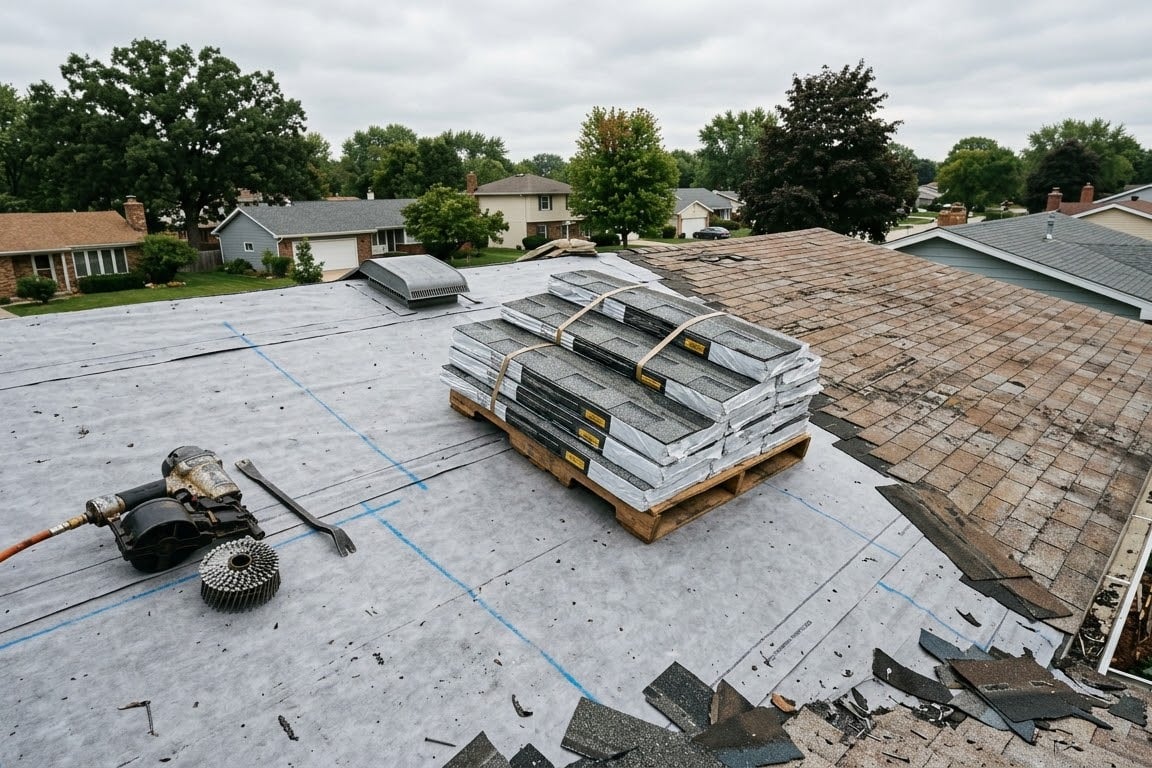
Why a new roof is priced by the square
Every roofing quote is built from the same unit: the square, 100 sq ft of actual sloped surface. Shingles ship three bundles to the square, underlayment is sold by squares of coverage, and labor is bid per square — so the whole trade prices in it.
Roof replacement cost ≈ (footprint × pitch factor ÷ 100) squares × installed rate per square, plus adders: extra tear-off layers, decking repair, steep-pitch access, and flashing work.
The pitch factor is the part homeowner estimates miss. A roof tilts, so its surface is larger than the footprint it covers — 11.8% larger at a common 6/12 pitch, 41.4% larger at a steep 12/12. Skip that multiplier and every number downstream is short. The widely published national average for an asphalt replacement sits near $10,000, with most jobs landing between $7,500 and $14,000 — and the per-square math below lands in the same window, which is a useful sanity check on any quote you receive.
Average roof replacement cost by house size
A 2,000 sq ft single-story house with a 6/12 gable roof costs about $10,100–$15,700 to reshingle in architectural asphalt; 1,500 sq ft runs $7,500–$11,700 and 3,000 sq ft runs $15,100–$23,500. One caution before the table: the footprint is what counts, not the living area. A 2,600 sq ft two-story house can carry the same roof as a 1,300 sq ft ranch — stacking floors is free roof.
| House footprint | Installed cost | The math (6/12 pitch, $450–$700/square) |
|---|---|---|
| 1,000 sq ft | $5,031–$7,826 | 1,118 sq ft of roof surface → 11.18 squares. |
| 1,500 sq ft | $7,547–$11,739 | 1,677 sq ft of roof surface → 16.77 squares. |
| 2,000 sq ft | $10,062–$15,652 | 2,236 sq ft of roof surface → 22.36 squares — the worked example below. |
| 2,500 sq ft | $12,578–$19,565 | 2,795 sq ft of roof surface → 27.95 squares. |
| 3,000 sq ft | $15,093–$23,478 | 3,354 sq ft of roof surface → 33.54 squares. |
National-average estimates, reviewed July 2026. The $450–$700 per-square rate is the same editable default our roofing calculator uses, compiled from the current roof-replacement cost guides published by the major home-services marketplaces and trade publishers, cross-checked against roofing contractors’ published pricing. Steeper pitch raises the multiplier and the per-square labor at the same time.
Roof replacement cost per square by material
Architectural asphalt shingles — the default on most US houses — run $450–$700 per square installed. 3-tab runs $350–$550, standing-seam metal $900–$1,600, and natural slate $1,500–$3,000. Material choice moves the total more than any other single decision, because it moves both the price per square and how many decades pass before you pay it again.
| Material | Installed per square | What you are buying |
|---|---|---|
| 3-tab asphalt | $350–$550 | The entry-level shingle: one flat tab pattern, lighter mat, 15–20 year service life. Cheapest up front, rarely cheapest per year. |
| Architectural asphalt | $450–$700 | Thicker laminated shingles, 25–30 year service life, better wind ratings. The default quote on most houses, and the rate this page prices with. |
| Exposed-fastener metal | $450–$850 | Screw-down panels, common on garages and outbuildings. The fasteners gasket through the panel face and want re-tightening over the years. |
| Standing-seam metal | $900–$1,600 | Concealed clips, panels that expand and contract freely, 40–70 year service life. Roughly double architectural asphalt up front. |
| Cedar shakes | $700–$1,400 | A thick, wind-resistant natural roof that wants periodic maintenance, and one many insurers surcharge in wildfire regions. |
| Clay or concrete tile | $800–$1,800 | A 50–100 year roof that weighs 6–10 lb per sq ft — an engineer may need to confirm the framing can carry it before anyone quotes it. |
| Natural slate | $1,500–$3,000 | The century roof. Material, specialist labor, and the structure to hold it all price accordingly. |
National-average estimates, reviewed July 2026, from the same source categories as above. Service lives follow the published InterNACHI life-expectancy chart linked below. Regional labor and material availability move every row — slate quotes in a city with slate roofers look nothing like slate quotes where the nearest crew is three hours away.
Two cross-checks worth knowing. The InterNACHI life-expectancy chart is the standard reference home inspectors use for those service lives. And if the metal premium tempts you for energy reasons, the Department of Energy’s cool-roof guidance is the honest version of the sales pitch: reflective roofing helps most in hot climates and least in cold ones, where it can slightly raise heating bills.
Worked example: a 2,000 sq ft house, line by line
Take a 50 × 40 ft single-story footprint — 2,000 sq ft — with a 6/12 simple gable roof, architectural shingles, one layer of old shingles to tear off:
- Roof area: 2,000 sq ft × 1.118 (6/12 pitch factor) = 2,236 sq ft = 22.36 squares
- Installed cost: 22.36 × $450–$700 = $10,062–$15,652
- Materials inside that price: 74 bundles at $42 ($3,108) plus underlayment, ice & water shield, drip edge, starter strip and ridge cap ($932) = $4,040
- Tear-off debris: 22.36 squares × 240 lb per layer = 2.68 tons — a 15-yard dumpster
Read the gap: everything between the $4,040 in materials and the installed price — 60–74% of the job — is labor, disposal, permits, overhead and margin. That is normal for roofing, and it is why quotes on the same house vary by thousands while the bundle count never changes. Enter 50 × 40 at 6/12 into our roofing calculator and it reproduces every line above, then lets you edit each price to match your local quotes.
Estimates only, not quotes. Prices are editable national averages — confirm current pricing and quantities with your supplier before you buy.
What moves a roof quote up: tear-off, decking, pitch
The per-square rate covers a straightforward roof. Four things commonly move a quote beyond it:
- A second tear-off layer. Each layer of old asphalt adds about 240 lb per square of debris plus the labor to strip it — on our example house, another 2.7 tons. The second layer you find out about on day one is the job’s most expensive surprise per pound.
- Decking repair — $75–$150 per 4×8 sheet replaced. Nobody knows how much rotted sheathing is up there until tear-off. A good contract names the per-sheet rate in advance instead of leaving it to a change order.
- Pitch above about 7/12. Steep roofs mean harnesses, staging, and slower work — the multiplier grows the area while the access grows the labor rate, a double hit.
- Complexity. Hips, valleys and dormers raise cutting waste from 10% on a simple gable to 15–20% — our waste factors reference breaks down why — and every chimney, skylight and wall junction adds flashing labor.
Region sits underneath all of it: labor is roughly 40–60% of a roof replacement, so the same house quotes differently in different labor markets, and both quotes can be fair. Ice-barrier membrane at the eaves is a code requirement in cold regions (2021 IRC, section R905.1.2) — verify what applies with your local building department.
Repair, layover, or replace
Most roof repairs run $400–$2,000 — a wind-lifted ridge, a failed pipe boot, flashing at one wall. Repair is the right call when the damage is localized and the shingles have years left. Replacement is the right call when damage covers more than about a third of the surface, or the roof is simply due: two repairs on a roof at end of life usually cost more than replacing it once.
The layover — new shingles nailed over the old layer — is the tempting middle option because it skips the tear-off line entirely. Some local codes allow one layover over a single flat, sound layer. What it costs you: nobody inspects the decking underneath, the new shingles telegraph every ridge in the old ones, several manufacturers trim the warranty, and the next replacement pays to strip both layers. It is a legitimate budget move on a sound roof and a bad one on a questionable roof.
Two boundaries worth stating plainly. A sagging ridge line or visible deck deflection is a structural framing question for a licensed professional — nothing on this page covers structural repair. And whether storm damage becomes an insurance claim is decided by your policy and your adjuster, not by a cost guide: document with dated photos and a written scope, and let those two argue it out.
Price your actual roof by the square
Every number above assumes an average roof, and yours isn’t one. The roofing calculator takes your real footprint and pitch, applies the same multiplier table and waste factors, and returns squares, bundles, every accessory in retail units, the materials subtotal, the installed range, and the tear-off tonnage — with every price editable, so a local quote can replace any national average on the spot.
If the roof tops a new outbuilding rather than the house, the cost to build a garage calculator prices the whole structure — slab, framing, roofing, doors and electrical — around the same roofing math.
Frequently asked questions
How much does a new roof cost on a 2,000 square foot house?
What is the cheapest roof material to replace?
How long does a roof replacement take?
Can I replace my roof myself?
Does homeowners insurance pay for roof replacement?
Should I repair my roof or replace it?
Where these numbers come from
The dollar figures are national-average estimates, reviewed July 2026, compiled from the current roof-replacement cost guides published by the major home-services marketplaces and trade publishers, cross-checked against roofing contractors’ published pricing. The asphalt per-square rates are the same editable defaults our roofing calculator ships with. Pitch multipliers are trade geometry (slope length ÷ run); coverage and packaging figures come from manufacturers’ product data sheets; service lives follow the InterNACHI life-expectancy chart linked above. Where building code is referenced, the number is the common IRC benchmark — local amendments win, so verify with your building department.
Our full sourcing and review process is on the methodology page, and the takeoff method behind the square-and-bundle arithmetic is on how to estimate materials.
Written and maintained by TallyTakeoff Editorial. No individual bylines, no invented credentials — see about TallyTakeoff for how that works and why.