Basement Waterproofing Cost: Priced by the Linear Foot
Most basement waterproofing jobs cost $2,500–$15,000. Contractors price by the linear foot of foundation perimeter, not by floor area: an interior perimeter drain runs $40–$100 per foot plus $1,200–$3,000 for the sump system, and full exterior excavation runs $100–$250 per foot. This page shows the per-foot rate for every method, works a 1,000 sq ft example line by line, and — because it is the cheapest advice on the page — tells you what to fix for under $1,500 before you sign for any system at all.
TallyTakeoff Editorial · Published
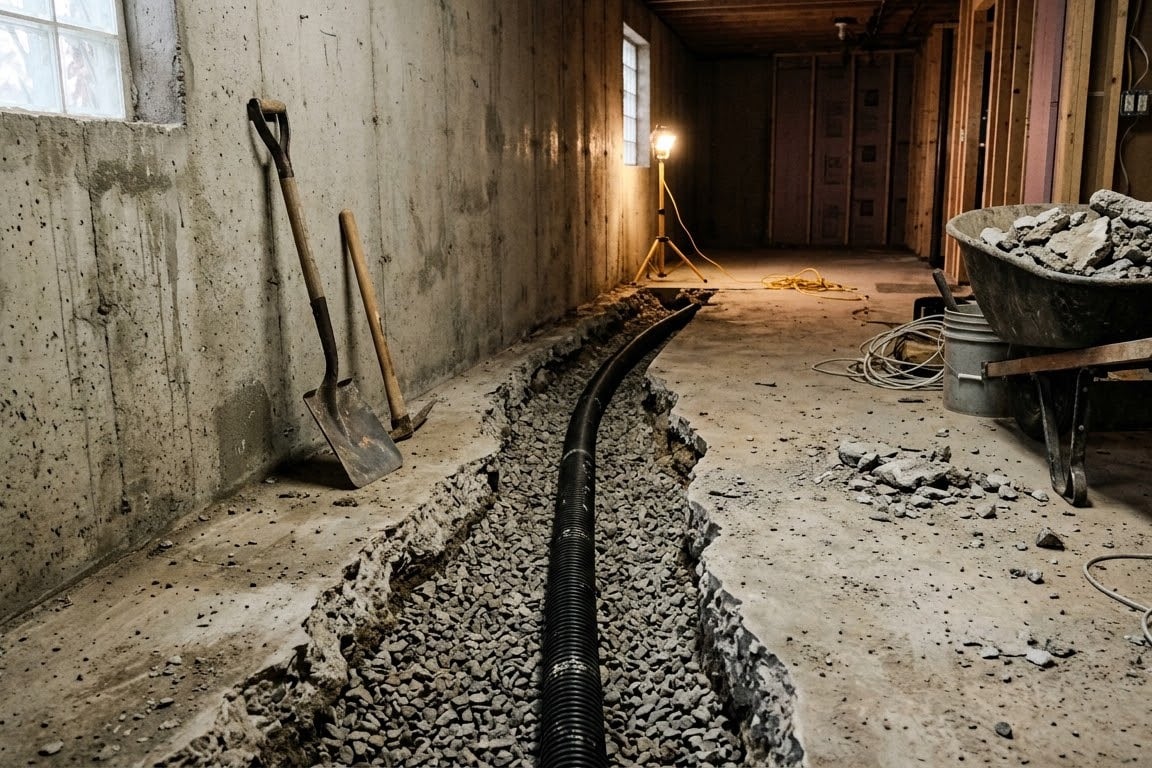
Why waterproofing is priced by the linear foot
Water comes in at the edges — through the wall face, through the cove joint where the wall meets the floor, or up through cracks near the footing. So the work happens at the perimeter, and the perimeter is what you pay for. A 1,000 sq ft basement and a 2,000 sq ft basement are not twice apart in waterproofing cost; they differ by the ratio of their perimeters, which is much smaller.
Waterproofing cost ≈ treated perimeter (linear ft) × per-foot rate for the system, plus fixed items: sump basin and pump, battery backup, discharge line, window wells, dehumidifier.
For a rectangular basement, perimeter is 2 × (length + width). The word treated matters: a contractor quoting the two walls that actually leak will come in at roughly half the price of one quoting all four, for the same basement, and both quotes are legitimate. When two bids are far apart, the first thing to compare is the linear footage each one covers — not the price.
Basement waterproofing cost by method
| Fix | Typical cost | When it is the right fix |
|---|---|---|
| Gutter cleaning, downspout extensions, regrading | $0–$1,500 | Always first. A surprising share of "basement leaks" are roof water dumped at the foundation, and this is the only fix that removes the water instead of managing it. |
| Crack injection (epoxy or polyurethane) | $300–$800 per crack | A single weeping crack in a poured-concrete wall. Injection fills the crack full-depth; a surface patch alone does not hold. |
| Interior masonry sealer, DIY | $650–$1,100 in material | Damp, bare masonry walls without water under pressure. Blocks vapor and minor seepage — not a fix for hydrostatic leaks. Figure shown is for a 1,000 sq ft basement. |
| Sump pump system (basin, pump, discharge) | $600–$2,500 | Water collecting under the slab with nowhere to go. Usually installed as part of a drain system, occasionally alone in a low spot. |
| Interior perimeter drain + sump | $4,000–$15,000 | Water at the wall–floor joint on one or more walls after the outside fixes are done — the standard cure for hydrostatic seepage. |
| Exterior French (curtain) drain | $3,900–$11,700 for 130 ft | Surface and shallow groundwater moving toward the house across a slope. A trench drain uphill of the wall, no excavation to the footing. |
| Exterior excavation, membrane + footing drain | $10,000–$30,000 | Chronic seepage through the wall face itself, or any time the wall is already being dug up for another repair. |
National-average estimates, reviewed July 2026. Compiled from the current cost guides published by the major home-services marketplaces and trade publishers, cross-checked against waterproofing contractors' published price sheets. Labor is the bulk of every figure except the sealer, so regional wage differences move these more than material prices do.
Cost per linear foot, system by system
| System | National average | What the price includes |
|---|---|---|
| Interior perimeter drain (drain tile) | $40–$100 /ft | Cutting and removing the slab edge, perforated pipe bedded in washed stone, wall vapor barrier tucked into the channel, concrete patched back. The sump system is usually its own line. |
| Exterior excavation waterproofing | $100–$250 /ft | Excavation to the footing, wall cleaned and sealed with a membrane, new footing drain, backfill. Repairing what the excavator does to landscaping is often excluded — ask. |
| Exterior French / curtain drain | $30–$90 /ft | Trench, filter fabric, washed stone and perforated pipe, graded to daylight or a catch basin. No wall work at all. |
| Footing drain tile at new construction | $25–$55 /ft | The same pipe-and-stone assembly laid beside the footing before backfill. Cheap while the hole is open; an excavation project forever after. |
National-average estimates, reviewed July 2026, same source categories as above. Block (CMU) walls tend toward the high end of the interior-drain range because the cores are drilled so the wall can weep into the channel.
If you are pricing a DIY curtain drain, the stone is the main material cost, and it is a volume problem: a 130 ft trench 12 inches wide and 24 inches deep holds about 9.6 cubic yards of washed stone. The gravel calculator turns trench dimensions into cubic yards and tons so the delivery matches the hole.
Worked example: a 1,000 sq ft basement
Take a 25 × 40 ft basement — 1,000 sq ft — with seepage at the wall–floor joint after heavy rain, gutters and grading already checked. Perimeter is 2 × (25 + 40) = 130 linear feet. A full-perimeter interior system at a typical $70 per foot:
- Interior perimeter drain: 130 ft × $70 = $9,100
- Sump basin, primary pump, discharge line: $1,800
- Battery-backup pump (the storm that floods the basement is the one that takes the power out): $1,200
- Total: $12,100
Run the same job across the full rate spread and the range is honest rather than vague: 130 ft at $50–$100 is $6,500–$13,000, plus $1,200–$3,000 for the sump options, so $7,700–$16,000 all-in.
Now the partial version, because it is the more common quote: if only the two uphill walls leak, that is 65 ft × $70 = $4,550, plus the same $1,800 sump — $6,350. Same basement, same system, half the price. This is why two honest contractors can be $6,000 apart, and why the linear footage on the quote is the first number to read.
Estimates only, not quotes. Prices are editable national averages — confirm current pricing and quantities with your supplier before you buy.
The cheapest way to waterproof a basement
Before any system goes in, take away the water you are currently delivering to the wall. University extension guidance is blunt on the order of operations: control surface water first, then worry about what is left. The list, costed:
- Clean the gutters and fix overflows — $0–$300. A clogged gutter pours the roof's entire catchment in a line at the foundation.
- Extend downspouts — $10–$50 each. The University of Minnesota Extension's basement moisture guide calls for discharge at least four feet beyond the wall; farther is better, and buried extensions to daylight beat everything.
- Regrade the first few feet — $500–$1,500 if you hire it. The residential-code benchmark is 6 inches of fall within the first 10 feet; verify specifics with your local building department. Soil settles against foundations over the years, quietly reversing the slope the builder left.
- Cover the window wells — $30–$80 each. An uncovered well is a rain gauge bolted to your foundation.
None of this is glamorous, which is exactly why it gets skipped in favor of a $12,000 system that then spends its life pumping water the downspouts could have carried away for $40. Do the cheap list, wait for two hard rains, and re-assess.
What you can do yourself, and what it actually costs
Masonry waterproofing sealer is the classic DIY layer, and the math is worth doing before you commit a weekend to it. That 1,000 sq ft basement has 130 ft of wall; at 8 ft tall that is 1,040 sq ft of wall face. Per the manufacturer's data sheet, coverage is 75–100 sq ft per gallon and two coats are required for the waterproofing warranty — so 21–28 gallons, or five to six 5-gallon pails, roughly $650–$1,100 in material at prices reviewed July 2026.
Two catches the label is honest about and buyers often are not. It bonds only to bare masonry — previously painted walls must be stripped, and efflorescence (the white mineral bloom) scrubbed off first, which is most of the labor. And it resists damp and minor seepage, not water arriving under hydrostatic pressure; sealing a wall that floods at the floor joint moves the leak, it does not stop it.
Crack injection sits in the same honest-DIY category: polyurethane kits for a typical 8 ft poured-wall crack run $60–$150, against $300–$800 for the same crack done professionally. The downspout, grading and window-well work from the previous section is all DIY by default. What is not DIY: anything involving a concrete saw at the slab edge or an excavator at the footing.
Interior vs. exterior: different jobs, not rival brands
An interior perimeter drain does not stop water entering the wall — it concedes the wall, catches the water at the footing, and ejects it with a pump. Exterior excavation with a membrane is the only method that keeps the wall itself dry. That distinction, not marketing, is what the 2–3× price difference buys.
In practice the interior system wins most retrofits anyway: it costs $40–$100 per foot against $100–$250, it works in winter and under decks and additions where an excavator cannot reach, and its 20–25 year service life is limited mainly by the sump pump, a $500–$1,500 wear item on a 7–10 year cycle. Exterior work earns its price when the wall face itself is chronically wet, when interior floor space cannot be disturbed, or when the foundation is already being excavated for another reason — a membrane added to an open hole is cheap insurance on a 30-plus-year life.
One boundary worth stating plainly: if a wall is bowing inward, shows a long horizontal crack, or has stair-step cracking with displacement in block, that is a structural repair question, not a waterproofing one. Price it with a licensed structural engineer and your local building department — nothing on this page covers structural work.
Waterproof before you finish — the order is the budget
Waterproofing and finishing are one project in the wrong order and two projects in the right one. The interior drain system needs the slab edge and 2–3 ft of bare wall along every treated run; retrofit it under a finished basement and you buy the system plus the demolition and rebuild of the drywall, baseboard and flooring in front of it. Waterproof first and the system disappears behind the framing at no extra cost.
The stakes are the finish itself. A water event in a finished basement runs $1,400–$6,300 in repairs plus $500–$3,500 in mold remediation as national-average estimates — and per EPA mold guidance, wet materials need to be dried within 24–48 hours to head off mold at all, which is not a window a vacation survives. Against a finishing budget that lands at $38,000–$58,600 in the worked example on our basement finishing cost calculator, the waterproofing line is the cheapest part of the project to do early and the most expensive to do late.
That calculator carries moisture remediation as its own line item for exactly this reason — set it from the numbers on this page, then price the framing, drywall, egress and bathroom on top of a basement that will stay dry under them.
Frequently asked questions
How much does it cost to waterproof a 1,000 sq ft basement?
Is it cheaper to waterproof a basement from the inside or outside?
What is the cheapest way to waterproof a basement?
Can I waterproof a basement myself?
How long does basement waterproofing last?
Is basement waterproofing worth the cost?
Where these numbers come from
The dollar figures are national-average estimates, reviewed July 2026, compiled from the current basement-waterproofing cost guides published by the major home-services marketplaces and trade publishers, cross-checked against contractors' published per-foot price sheets. Coverage and application figures come from manufacturers' product data sheets; moisture-control sequencing follows the University of Minnesota Extension guidance linked above and EPA moisture and mold guidance. Where building code is referenced, the number is the common IRC benchmark — your local amendments win, so verify with your building department.
Regional labor is the biggest source of spread in every installed figure: the same 130 ft interior system quotes differently in Buffalo and in Dallas, and both can be fair. Our full sourcing and review process is on the methodology page, and the takeoff method behind the trench-stone and sealer arithmetic is on how to estimate materials.
Written and maintained by TallyTakeoff Editorial. No individual bylines, no invented credentials — see about TallyTakeoff for how that works and why.